
A PRIMER ON RELOADING :
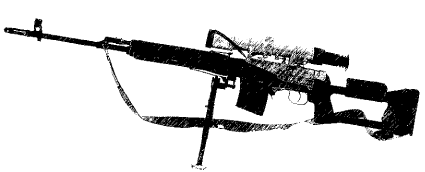
Making your own cartridges for your Dragunov or PSL is one of the best ways to get better performance from your rifle. If you are scratching your head as to why you can’t shoot better than 3 inch groups at 100 yards, reloading may be just the fix.
Getting started in this activity can not only be confusing, but quite intimidating. This is only confirmed by the wide variety of manuals and videos on the subject, which sometimes give conflicting instructions. I couldn’t begin to explain everything necessary to the new or novice reloader but I'll briefly explain my own experience which you can use as a guide: Tools: I bought the Lee Anniversary kit and a set of RCBS 7.62x54R dies. This is probably the cheapest way to get started and will meet all your needs until you get so good (probably years from now) that you need a more expensive set up that does more with greater precision. The Lee kit will get you good consistent loads that give you very satisfying results.Components: The first thing people always tell beginners is: "Get a reloading manual". Lee includes one in their kit. It's pretty good but you should get another one anyway. Some people say the Speer loading manual is quite good. The manual will tell you about all the powder types and bullets types and how much to use of each when making bullets. Also check the reloading discussion forums for good tips from RKI's at gunboards.com and Cast Boolits, among others. Use the Search feature on these forums before asking newbie questions. Where to buy: Midway and Graf & Sons are a good start. There are other web sites too, do a search using google or yahoo.com. Keep an eye out for what's on sale (changes monthly and even weekly on these web sites). You'll also need a work area for all this. Most people will use their garage or basement. It needs to be someplace with no exposed flame and good ventilation. Just use your common sense (you are dealing with explosives after all). The reloading press will need to be secured with bolts or screws into a solid table. Some folks who live in apartments have a rolling device, like a TV stand with a cabinet below, and can roll the thing into a closet when not in use. Bottom line is that reloading is not easy to teach yourself. I learned that the hard way. People talk like it's no big deal and reloading your own guarantees better accuracy. If you have that expectation you will get frustrated quick. I had no tutoring and this was before I was on the internet very much so it took me about a year of trial and error until I "got it". There are some very good videos on youtub.com where people demonstrate their reloading technique. Just be aware, some people who claim to be experts often get certain things wrong (without realizing it). So this is where watching several videos, reading articles, etc can help distill all the information down to something that is the safest and most correct method for you. Ultimately you are going to need to determine which brand of brass is best (Norma, Lapua, Sellier & Bellot, etc), which .311 bullet (Sierra, Nosler, Speer, etc), bullet weight (174gr HPBT, 180gr SN, etc), Powder brand (IMR, Hodgdon, Accurate, etc), Powder charge (how much powder to use), bullet seating depth (how far down to mash the bullet into the case, yes this really does matter), and finally which primer to use (CCI, Winchester, etc). Here's a more realistic look at what will happen:
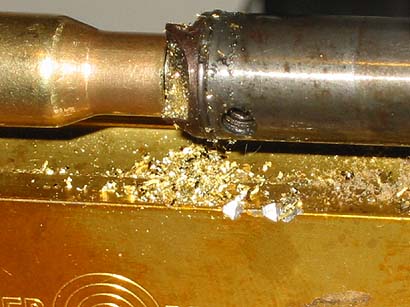
You'll buy everything and just as you start pouring the powder you'll realize you don't have a crucial tool or something which will take 2 weeks to be delivered. Then you'll finally get everything and load up about 20 or 30 rounds and the accuracy will suck. You'll load up 40 more, head to the range, and it will be no better. After giving ONE MORE try before putting everything up for sale you'll mysteriously get a 5 shot group that cloverleafs a sub-inch group. Motivation returns and you try to duplicate that load. Finally you'll realize that yes, I have to read the whole manual and read all the postings and tips to find the little nuances to getting this thing to work right. The day will come when you get that perfect combination of powder type/charge weight/ bullet weight/ bullet seating depth. You'll have written down this recipe (very important) and go on to repeat this load for very satisfying days at the range, impressing your friends with your great feats of marksmanship. Here's a helpful tip that is not often in the manuals: The manual assumes you are using BRAND NEW components generally. This means that if you use once-fired brass fired in your or someone else’s rifle, you will need to get that case ready for your use in several ways. First you'll need to buy a caliper tool to measure the length of the case. Then you'll need to buy a case trimmer because the cases often stretch when fired. You should never use someone else’s reloads or reload a case that's from someone else’s rifle unless you're certain the shell casing has been squeezed back into a shape that will fit your rifle's chamber. Remember all rifles' chambers are not the same dimension , even if they are the same caliber. A worst case scenario of this can cause an out-of-battery detonation and will destroy your rifle and probably injure you.
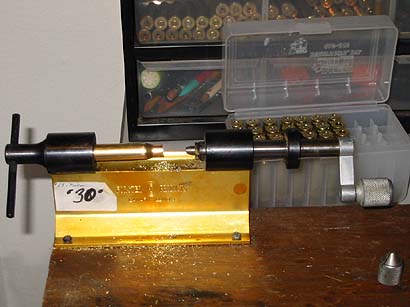
Forster Case trimmer resizing a 7.62 NATO case.
Ok, now that I've killed any desire for you to get into reloading let me say this: Once you find that "Pet Load" and have confidence in your reloading technique, shooting satisfaction will increase at least 3 fold for you. Not only will it cost you less money to shoot, but you will ALWAYS shoot more accurately than if you had used commercial or surplus ammo. I now load 5 or 6 calibers and never even think about buying commercial ammo for some of my rifles.
Remember, these are only the basics. You should take advantage of the wealth of knoweldge that can be accessed just by talking to other shooters at the range or online. And when you've gotten your first great grouping at the range, let us know about by posting a report to a discussion forum found on the links page.